

A brand asks why its ad ran on a particular screen, at a particular price. Until recently, the answer sat in the buyer’s own bidder. With containerized bidding, it sits inside the exchange.
PMG is piloting streaming TV buying inside Index Exchange’s own infrastructure, with the bid decisions made by Bedrock’s containerized DSP running in Index Cloud, next to the auction itself. Bedrock described the move as “bringing our decisioning closer than ever to the impression”. For a buyer, that is mostly good news: the model that values the impression now sits where the impression is created.
It also leaves a gap.
When the decision happens inside the exchange, in signed code the advertiser never sees, what is left to show why a person saw an ad?
What containerization in programmatic advertising fixes
Containerization moves the decision to where the impression is created. Instead of sending a bid request across the internet to a bidder and waiting for an answer, the exchange hosts a signed copy of a buyer’s or partner’s model and runs it locally. It is supply-side decisioning on the buyer’s behalf: less data travels, and less time is lost on the way.
The buyer benefit is depth. Bedrock’s head of engineering, Damian Naglak, put it this way: “the bidder can evaluate every impression on a deal, not a sampled slice.” Brands see the same opening. Hyundai’s CMO, Sean Gilpin, told AdExchanger he wants brands “to be able to do their own custom valuation on inventory.”
The standard is moving in step. IAB Tech Lab declared the Agentic RTB Framework (ARTF) final in August, and by default its agents run with no external network access.
We have backed this direction before, in our posts on upstream traffic shaping and the AI innovators rebuilding programmatic infrastructure. This post does not walk that back. It asks for the one thing the architecture still lacks.
What the Agentic RTB Framework guarantees, and what it leaves to the parties
ARTF belongs to the same family of agentic standards as AAMP 3.0, which we covered from the sell side in October. Its vocabulary matters here, so a quick decoder: the exchange that hosts the containers is the orchestrator, the containers are agents, and the changes an agent makes to a bid request are patches, sometimes called mutations.
On the container itself, the ARTF 1.0 final spec is firm. The code must be signed, so the host knows exactly which version is running: “Image signing and verification must be enforced across all deployments.” Logging must be built in: “Standard logging and monitoring must be integrated into all deployments.” And agents get only the access and data they need: “Agents must adhere to the policy of least-privilege and least-data.”
The record of what the container did is softer. On reporting, the spec says, “Orchestrators should provide standard reports and metrics to judge the acceptance rate of mutations and rejection reasons.” Should, not must. On whether the company that supplied the model ever hears what happened to its changes, it says, “Whether and how orchestrators will communicate choices to accept or reject patches to agent providers is left to the parties.”
Consent gets a single line: “It is the container’s responsibility to honor all of the specified behavior in the RTB request.” The spec names no check that it did.
A critic quoted in PPC Land’s ARTF explainer put the result in one phrase: “the guarantee becomes the signature rather than the record.”
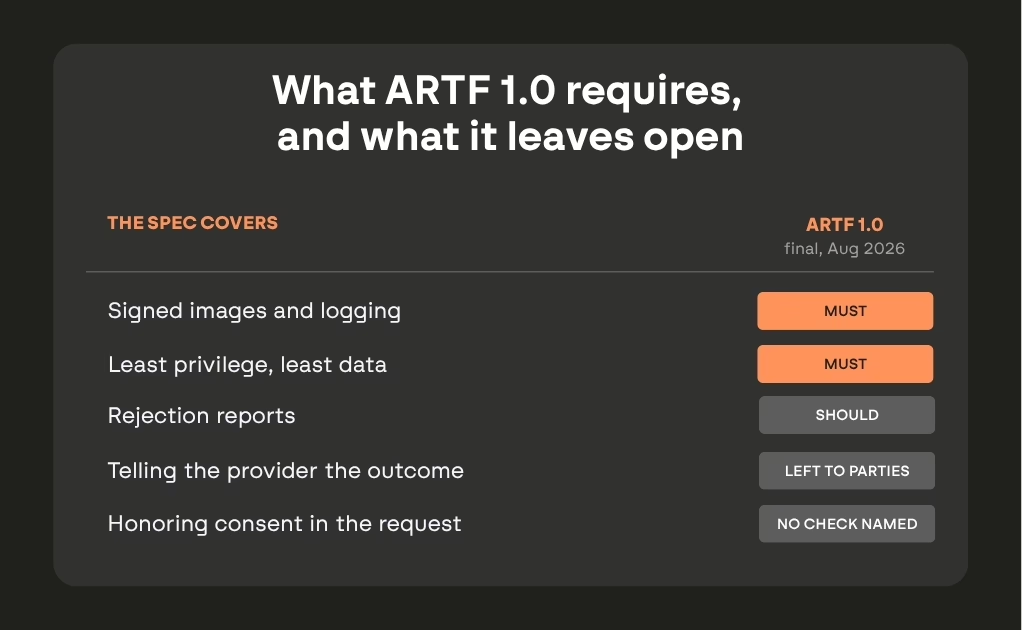
Source: IAB Tech Lab, Agentic RTB Framework 1.0 FINAL
Why the person behind the pixel needs the record
A container does more than bid. Under ARTF, it can apply intents: activate audience segments, activate deals, adjust a deal floor, shade a bid. Each one changes what a person sees and what a brand or publisher pays. Each one is exactly what they will want explained after the campaign.
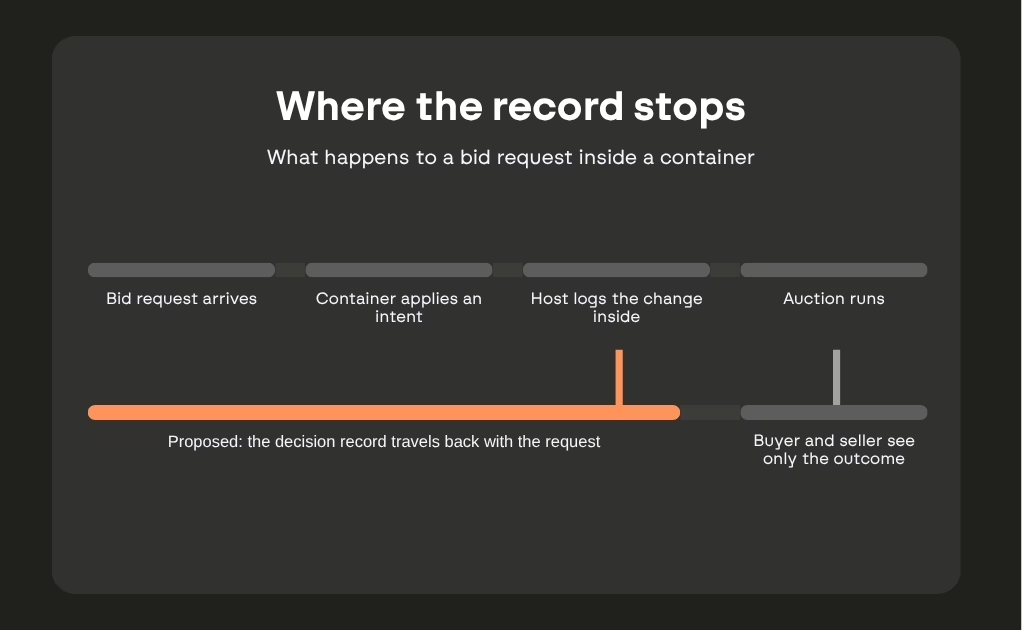
Today’s path in grey, the proposed decision record in orange. Based on the Agentic RTB Framework 1.0 FINAL
Part one of this series, Sacha Glasroth’s upcoming post on server-side identity, argues that consent has to travel into the request. The same logic runs the other way. The decision trail has to travel out of it.
The measurement world already asks this of complex and AI systems. The Media Rating Council’s auction transparency standards say “Key components and decision criteria must be documented and disclosed.” A container is one more decision-maker in the auction, and its decisions belong in the same disclosure.
Inside the container, the request is the record. While that record stays inside the host, the buyer and the seller on either side of the deal cannot read it. Container transparency has to mean the decision is readable, not only that the code is signed.
What a decision record should hold
The fix starts from something the spec already has. ARTF notes that “OpenRTB patch facilitates auditability within an orchestrator’s environment by logging requested and applied patches.” In plain terms, there is already a bid request audit trail. It just stays inside the host. A decision record would carry it back out, attached to the request, to the buyer and the seller.
Four fields would cover it:
- Intent applied. Which ARTF intent the container used, from segment activation to bid shading.
- Outcome and reason. Whether the host accepted or rejected the change, and why.
- Consent state. The consent signals present when the decision was made.
- Container identity. The signed image and version that decided.
Two of these are already logged or signed inside the host today, and a third is something the spec says hosts should report. What is missing is the requirement that they leave the host.
IAB Tech Lab has opened version 2.0 for proposals. Version 1.0 made the container trustworthy. A decision record is what 2.0 should add, so its decisions become legible too.
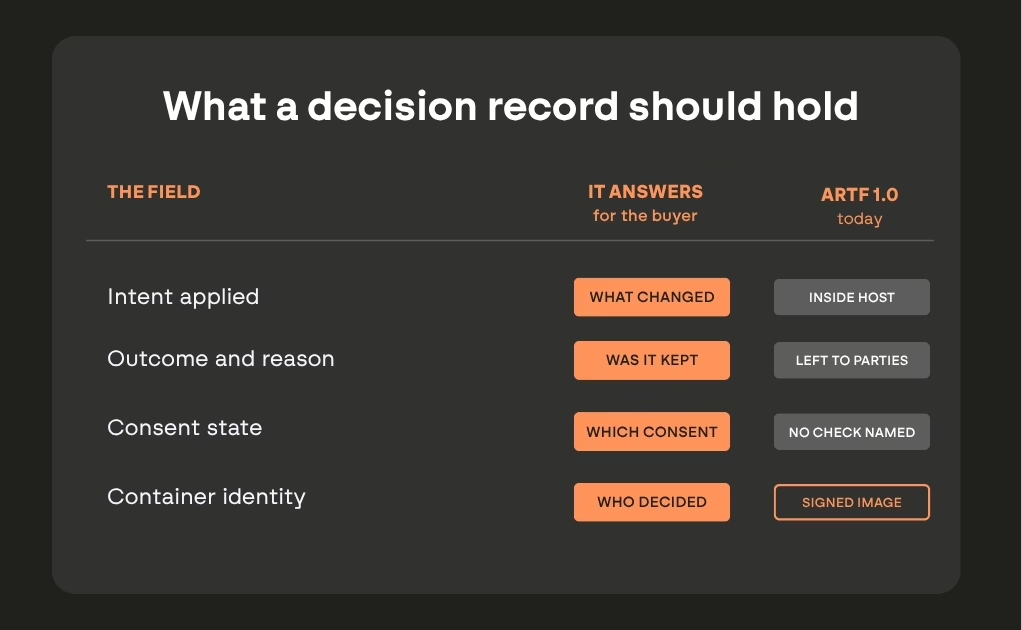
BRAVE’s proposal, based on the Agentic RTB Framework 1.0 FINAL
3 questions to ask before you buy inside a container
Buyers do not have to wait for 2.0 to start asking for the record. On the next call with an exchange that hosts partner models, ask:
- When a partner model decides inside the exchange, can I see which of its changes to my deals were accepted?
- Is the consent state logged next to each decision?
- Which model version made the call?
Where the answers run out is where the record stops. Inside the container, the request is the record.
The decision moved inside the exchange.
The record should move with it.