

On a bus/café/workspace somewhere this morning, someone is 3 episodes into a story about a billionaire’s secret heir. Each episode runs about a minute, shot vertically for mobile screens. Each ends on a cliffhanger.
This ‘someone’ will be back at lunch, and again tonight.
There are enough of these ‘someones’ to make the time-spent tables now read like a misprint. ReelShort users spend 35.7 minutes a day inside the app. For comparison: Prime Video gets 26.9, Netflix gets 24.8, Disney+ gets 23. Those are US figures, per Omdia’s analysis of Sensor Tower engagement data reported in March 2026. ReelShort’s mobile audience is a fraction of Netflix’s, which is the point: per user, it holds them longer
Demand caught up in April. The Trade Desk became DramaBox’s first-ever DSP partner, live globally, opening a micro-drama segment to programmatic buying at brand scale. The category’s top 20 apps reach 250 million monthly active users by Owl & Co.’s count.
A business built on coin unlocks and rewarded video is now selling its inventory to brand budgets. Budgets arrived before supply-quality standards did, and that gap is what arbitrage needs.

Source: Omdia analysis of Sensor Tower data
A coin economy grows an ad business
The flood is structural, not optional
The volume is coming because of where the audience lives. Southeast Asia, Latin America, and India drive roughly 77% of new downloads in the category, and each grew more than 100% year on year. Revenue per download runs about 17 times higher in the US than in Latin America. Only a small minority of users ever pay, and in mature markets a user often costs more to acquire than they return in purchases. For everyone else, the person on the bus/café/workspace included, the show was always going to be free. Enormous audiences sitting in low-ARPU markets monetize one way.
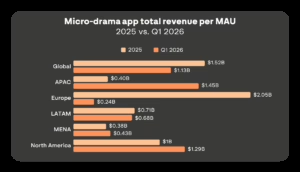
Source: State of Short Drama Apps 2026, Sensor Tower
Their attention is getting more valuable, fast. Set full-year 2025 revenue per monthly active user against the first quarter of 2026 alone. APAC went from $0.40 to $1.45. North America went from $1.00 to $1.29. MENA went from $0.38 to $0.43. Three months out-earning twelve, per user, in the regions carrying the category’s growth.
That figure counts everything an app earns, coin purchases and advertising together, so it cannot be split from the outside. What it gives us is direction and pace. And in markets where only a small minority ever pay, a climb that steep is hard to account for from coin purchases alone. A coin economy grew an ad business, and it took about a year.
It is already working. Ad-supported apps hold the best retention in the category, with 25% to 30% of users still active at day 30 against 15% to 20% for coin-led apps. FreeReels, free to watch and paid for by advertising, has passed 100 million installs and grew 123% quarter-on-quarter.
The distribution is widening too. The DramaBox partnership does not route this inventory into a mobile exchange, it routes it onto the open internet, where brand budgets already sit. That is the step that turns micro-drama advertising from an app-monetization line item into open programmatic supply.
Now come back to the person on the bus/café/workspace, because the arithmetic runs through them. Short drama users average 25 minutes a day, closer to 40 in Southeast Asia. Free tiers in this category can carry an ad every minute or two. That is 12 to 25 ad opportunities per person, per day.
Those impressions are unusually alike. Same vertical format, same episode lengths, same rewarded mechanics, across thousands of near-identical apps. When inventory grows this fast and looks this uniform, the paths to it multiply faster than anyone audits them.
#microdrama coin economy grew an ad business. And it took about a year. Share on XEvery young category gets flooded before it gets filtered
This pattern isn’t new. Mobile video lived it. CTV is living it now. Fast-growing inventory attracts rebroadcasting, duplication, and resold paths, and it does so before the standards catch up.
Buyers already know what to do about it. The discipline is settled: trace the path, read the SupplyChain object, hold a position on reseller hops, and know the difference between direct and resold. We set out the four things worth evaluating in a supply partner in June, and the framework still holds.
What has not happened is anyone pointing it at this category. Micro-drama grew up outside the open web, in app stores and coin economies, and the buy side’s path discipline has simply never been aimed there. The framework is sitting ready. The inventory is arriving now.
#microdrama grew up outside the open web, in app stores and coin economies, and the buy side's path discipline has simply never been aimed there Share on XCurated or arbitraged, the only question that matters
Two kinds of supply are about to carry the same content, and they will not look different in a bid request. Same episode, same viewer, same minute of attention, two very different paths behind it.
Curated supply earned its admission. It met explicit criteria before it entered the package, the path to it is direct, the impressions are de-duplicated, and every party in the chain is disclosed. Arbitraged supply was repackaged and resold. The path adds cost, and it subtracts nothing you can name.
In this category, the difference is concrete. Provenance looks like a declared seller, a clean app-ads.txt, and a path you can trace back to whoever actually operates the app. Repackaging looks like the same impression reaching your seat through several dressed-up routes, each one taking a margin, none of them adding a thing.
The reason this compounds now sits in what makes the inventory attractive in the first place. Announcing the DramaBox partnership, The Trade Desk’s Douglas Choy described short drama as “a high-value environment combining scale and frequency.” He is right, and each of those qualities also describes conditions arbitrage looks for. Scale means there is plenty to go around. Frequency means one user generates impressions all day. Brand budgets mean the prices are worth farming. Put those three together in a category with no established provenance norms, and repackaging becomes a rational business.
Curation is a standard, not a segment. It is the thing that decides which of those two paths your budget is buying.
2 kinds of #microdrama supply are about to carry the same episode. Curated earned its admission. Arbitraged was repackaged and resold, and the path subtracts nothing you can name. Share on XWhat the market that invented the category already knows
Micro-drama did not begin in an app store. It began in China, as duanju, and our team spent time in that market this year. Two observations came home with us.
Commerce here runs on relationships rather than pipelines. Deals move on WeChat and through direct contact, not through calls and connection requests. The operators taking vertical drama overseas are deliberate and professional, and they evaluate partners the way they expect to be evaluated: on who actually shows up, and who stands behind their side of the deal. That is worth noticing, because it means this is a category whose builders already think in terms of accountability.
The second observation is about where value is heading. Production costs are collapsing, with AI-assisted work running around $30 per finished minute against $150,000 to $250,000 for a traditionally shot series, and catalogs are increasingly licensed and translated at scale. When content gets that cheap, the durable value moves to how the attention is monetized. That is exactly the layer where supply paths diverge.
Three questions to ask before the flood arrives
These questions matter the first time this inventory shows up in a package you are buying, whatever your position on the category.
- Who operates this app, and does its app-ads.txt say so? Licensed catalogs, translated libraries, and white-label builds make that a harder question here than the file makes it look.
- At 12 to 25 ad opportunities per user per day, how many routes are carrying the same one?
- This category has thousands of near-identical apps. Which of them are in your package, and what did they have to show to get in?
Somewhere, the person on the bus/café/workspace just tapped into the next episode. A category this human deserves: paths you can stand behind.